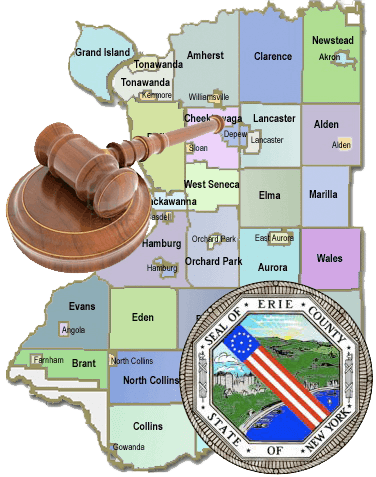
A drinking-and-driving charge filed in the Alden Town Court lands in one of the rural justice courts that sit along the eastern edge of Erie County, far from the bustle of downtown Buffalo. The procedures are the same statewide, but the setting is local, the calendar is part-time, and the experience of a defendant here is very different from a crowded city courtroom. Bakshi & Leta have appeared in the town and village courts east of Buffalo for decades, and we know how a case like yours travels through a court the size of Alden’s.
The Town of Alden stretches across the farmland and open country of east Erie County, bordering Genesee County to the east. Within its boundaries sits the smaller, separately incorporated Village of Alden, which keeps its own justice court, a distinction that surprises many drivers and, as we will explain, can decide which courtroom you walk into. Knowing how the town court works, and where your particular charge belongs, is the first move toward protecting your license and your record.
Town and village: two courts, one name
Here is a wrinkle unique to Alden. The Town of Alden wraps entirely around the Village of Alden, and each level of government runs its own justice court. The location of your traffic stop decides which one hears your case. A stop on a town road, whether out on Crittenden Road, along Exchange Street, or on the rural stretches of Broadway (Route 20) outside the village, generally routes to the Alden Town Court. A stop on a street within the village limits may instead be filed in the Alden Village Court. No sign on the road tells you where one ends and the other begins, and a case sent to the wrong court only adds delay. Confirming the correct court is one of the very first things we do for you.
How a New York town justice court operates
New York gives its towns the authority to hear a broad span of criminal matters, including misdemeanor DWI charges, through their justice courts. The Alden Town Court is one of these. It is run by a town justice and sits on a part-time schedule rather than the daily docket of a large city court. In practice, that means court dates are spaced further apart, and a case can move slowly through arraignment, motion practice, conferences, and resolution. That unhurried pace is exactly why having counsel who keeps the matter advancing, rather than letting it drift between distant dates, pays off.
The slower cadence of a rural town court is not all bad news. The same gaps between dates that can stretch a case out also create room to do the work that improves an outcome: to obtain and scrutinize the discovery, to investigate the stop, to gather records that put your situation in context, and to open a constructive dialogue with the prosecution. A case that is managed well in the time between appearances arrives at each court date in a stronger position than one that simply waits. We use those intervals deliberately rather than letting them go to waste.
The stages your case moves through
However local the courtroom, a DWI in Alden travels the same path as any other New York case. It opens with the arraignment, then moves into the exchange of discovery: the police paperwork, the breath-test records, any video, and the officer’s account of the stop. From there come the pretrial motions, where we can challenge whether the stop was lawful, whether the field sobriety tests were properly administered, and whether the chemical test was reliably conducted and the device properly maintained. Conferences with the prosecution follow, and if a fair resolution cannot be reached, the case proceeds toward a hearing or trial. Knowing where the pressure points lie in that sequence, and which ones apply to your facts, is the difference between reacting to events and steering them.
Where DWI enforcement happens around Alden
Broadway, carrying U.S. Route 20, is the main artery through the Town of Alden, threading east and west across the county and feeding steady through-traffic past farms, homes, and the village. Crittenden Road and Exchange Street connect the outlying hamlets and rural neighborhoods to that corridor, and on dark country roads with no streetlights, an officer’s attention can fix on a drifting lane line or a missed stop. Evening and weekend patrols climb around holidays and local events, and a stop that begins over something minor, such as a plate light or a wide turn, can turn into roadside field sobriety testing and a chemical test. Every one of those steps is governed by rules, and every one is a place a careful defense looks for an opening.
DWI versus DWAI in New York
The exact label attached to your charge matters more than most drivers realize. New York charges Driving While Intoxicated (DWI), a crime generally brought at a blood-alcohol content of 0.08% or higher, and Driving While Ability Impaired (DWAI), a traffic infraction typically charged between 0.05% and 0.07%. A reading of 0.18% or above becomes Aggravated DWI, with harsher penalties, and impairment by drugs is charged as DWAI–Drugs. The gap between these matters a great deal: a reduction from a DWI to a DWAI can be the line between a criminal conviction that follows you and a traffic infraction that does not. Working toward that kind of result is frequently the core of the defense.
The Bakshi & Leta approach in courts like Alden
Rural justice courts run on routine and relationships. Understanding how a particular town court sets its calendar, how the prosecution weighs a borderline breath test, and what the court expects of a defendant lets us steer a case efficiently and sidestep the missteps that stretch matters out. Sunil Bakshi and Joseph Leta have spent years in the justice courts of eastern Erie County, and we bring that hands-on familiarity to every Alden case we take.
Just as important, we keep you informed. From the day after the arrest, we explain what each appearance means, what the court is likely to do next, and what your realistic choices are. Facing a DWI is unsettling enough without being kept in the dark about your own case.
What is genuinely at stake
It is easy, in the disorientation that follows an arrest, to lose sight of how much rides on a DWI case in rural Erie County. Beyond the immediate question of your license sit the longer consequences: the way a criminal conviction can shadow employment and background checks, the sharp rise in insurance costs, and the cascade of obligations a conviction can trigger. For drivers in a community like Alden, where there is little public transit and a car is simply how life gets done, the loss of driving privileges is not an inconvenience but a genuine hardship. That is why we treat the early protection of your ability to drive, and the long-term protection of your record, as two halves of the same job. The goal is never merely to get through the next court date; it is to reach a disposition you can live with for years afterward.
One last point bears emphasis for anyone facing a first charge. A great many people who end up in a town court like Alden’s have never been in a courtroom before, have no prior record, and are frightened by the prospect of a criminal conviction. That profile is exactly the kind of case where a careful defense can matter most, because the available paths, from a possible reduction to programs that can soften the outcome for a first offender, depend heavily on how the case is handled from the beginning. Do not assume the result is foregone simply because a test was taken or a charge was filed. The facts of how you were stopped and tested, and the way your case is presented to this particular court, can shape what happens next.
Alden town court questions
Frequently asked questions
Call (716) 631-0004 for answers specific to your case.
It depends on where the traffic stop occurred. The Town of Alden completely surrounds the separate Village of Alden, so a stop on a town road such as Crittenden Road or Exchange Street generally routes to the Alden Town Court, while a stop on a street inside the village limits may be filed in the Alden Village Court. We verify which court holds your case before your first appearance.
The first court date is the arraignment. The charges are read, the court addresses your driving privileges, and any suspension is typically imposed at this point. We move immediately to pursue hardship privileges and, where you qualify, a conditional license so you can keep driving to work and other essential places while the case is pending.
DWI (Driving While Intoxicated) is a crime generally charged at 0.08% BAC or higher. DWAI by alcohol is a traffic infraction usually charged between 0.05% and 0.07%, and a BAC of 0.18% or above is charged as Aggravated DWI. Reducing a DWI to a DWAI can change a criminal conviction into a traffic infraction.
Yes. Sunil Bakshi and Joseph Leta have defended DWI cases throughout the town and village justice courts of eastern Erie County for years. We are accustomed to the part-time calendars and local procedures of rural town courts like Alden’s, and we handle the appearances so you are not left to navigate it alone.
DWI case in Alden Town Court? Call now.
The sooner you call, the more we can do to protect your license and your record. Free, confidential consultation.