When a DWI charge is set to be heard in the Alden Village Court, you are dealing with one of the small village justice courts that dot the eastern reaches of Erie County. These courts handle serious matters on a modest, part-time footing, and the experience is a world apart from a high-volume city courtroom. Bakshi & Leta have spent decades inside the village and town courts that surround Buffalo, and we understand how a case moves through a court the size of Alden’s, and how to keep yours on track.
The Village of Alden is a compact community tucked inside the larger Town of Alden, out where eastern Erie County runs up against farm country and the Genesee County line. Its village justice court reflects that small scale, with a part-time schedule and a calendar far shorter than the county courts in Buffalo. Getting your footing in this court, and knowing for certain that your case actually belongs here, is the first step toward defending your license and your record.
Inside the village, or out on a town road?
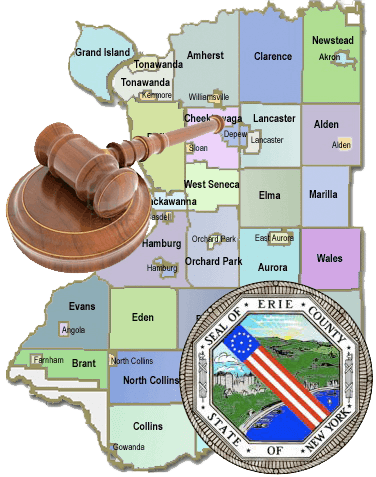
Alden presents an unusual jurisdictional quirk. The Village of Alden is fully enclosed by the Town of Alden, and each runs its own justice court. The decisive question is simple: where were you physically stopped? A stop on a village street, along Broadway or Main Street inside the village limits, generally routes to the Alden Village Court. A stop just beyond those limits, out on a town road, may instead be filed in the Alden Town Court. The boundary is not marked on the pavement, and a charge sent to the wrong court only invites delay. Pinning down the correct court is among the very first things we handle for you.
What a village justice court is
Under New York law, villages may operate their own justice courts with authority to hear a range of criminal matters, misdemeanor DWI charges included. The Alden Village Justice Court is one of them. A village justice presides, and the court ordinarily sits part-time rather than on a daily docket. The upshot is that court dates can be spaced out and a case may take time to work through arraignment, motions, conferences, and resolution. The laws are no different from anywhere else in the state, but the rhythm is distinctly local, and that is where experience in courts like this one earns its keep.
There is a human dimension to a small court that a larger one lacks. In a village courtroom the same handful of people tend to recur, and the proceedings are closer and more personal than the assembly-line feel of a crowded city docket. That intimacy can work in a defendant’s favor, because the court has the time to consider a person’s individual circumstances rather than rushing through a packed calendar. But it also means that how a case is presented, and how prepared and credible the defense appears, carries real weight. We come to a village court ready, organized, and respectful of how it runs, an approach that tends to be noticed in a setting this close-knit.
How challenges to a DWI charge actually work
A DWI case is built in steps, and each step is an opportunity for scrutiny. It begins with the lawfulness of the stop itself: an officer needs a valid reason to pull a driver over, and if that reason does not hold up, everything that followed can come into question. Next come the roadside field sobriety tests, which are supposed to be administered under specific conditions, conditions that a dark, uneven village street at night does not always meet. Then there is the chemical test, where the calibration and maintenance of the device, the timing of the test, and the procedures the officer followed all matter. We work methodically through each of these in the discovery and the pretrial motions, looking for the weaknesses that can reshape a case or open the door to a reduced charge.
The roads that lead to DWI stops in Alden
Within the village, Broadway and Main Street carry the bulk of local traffic, drawing residents and passers-through alike past the village’s shops and homes. On these streets a stop can begin with something thoroughly routine, such as a rolling stop at a corner, a burned-out taillight, or an unsignaled turn, before an officer’s roadside observations, the field sobriety tests, and a chemical test assemble the case the prosecution will lean on. Patrols tend to increase on evenings, weekends, and around local events. Each stage of that encounter is bound by rules, and each is a point where a thorough defense can search for an opening.
Understanding DWI and DWAI in New York
It is worth being precise about what New York actually charges, because the labels carry very different consequences. The state charges Driving While Intoxicated (DWI), a crime generally brought at a blood-alcohol content of 0.08% or higher, and Driving While Ability Impaired (DWAI), a traffic infraction usually charged between 0.05% and 0.07%. A reading of 0.18% or more is charged as Aggravated DWI, carrying steeper penalties, and impairment by drugs is charged as DWAI–Drugs. Why does the distinction matter so much? Because a reduction from a DWI to a DWAI can turn a criminal conviction into a mere traffic infraction, and negotiating toward that outcome is frequently where the real work of a defense lies.
What working with Bakshi & Leta looks like
Small courts operate on routine and familiarity. Knowing how a given village court schedules its calendar, how its prosecution sizes up a borderline test, and what the court expects of a defendant lets us move a case along efficiently and avoid the stumbles that drag things out. Sunil Bakshi and Joseph Leta have appeared throughout the village and town courts of eastern Erie County for years, and we bring that practical, on-the-ground knowledge to every Alden case.
We also keep you in the loop at every turn. Starting the day after your arrest, we walk you through what each step means, what the court is likely to do, and what your realistic options are. A DWI is hard enough without being left guessing about your own case.
Why moving quickly is worth it
The instinct after a DWI arrest is sometimes to wait, to hope the first court date sorts itself out, or to assume that because the village court sits infrequently there is no rush. That instinct works against you. The earliest days are when a license suspension is addressed and when a request for hardship or conditional driving privileges can be made, opportunities that are harder to recover if they pass. They are also when evidence is freshest and your own recollection of the night is clearest, both of which can matter to the defense. Reaching out early does not lock you into anything; it simply gives you options that erode with time. For residents of Alden, where errands, work, and family all depend on being able to drive, protecting that ability from the outset is usually the most pressing reason of all to call sooner rather than later.
It also helps to remember that a charge is not a conviction. The paperwork an officer files at the roadside represents the prosecution’s version of events, not a verdict, and that version has to withstand examination before it becomes anything more. For a first-time defendant in particular, someone with no prior record who never expected to find themselves in a village courtroom, the way a case is approached at the outset can open doors that stay closed for those who simply wait and hope. We look hard at the strength of the evidence, at whether the stop and the testing were done properly, and at every legitimate avenue toward a better outcome, so that you are making decisions from a place of understanding rather than fear.
Alden village court questions
Frequently asked questions
Call (716) 631-0004 for answers specific to your case.
A DWI charged on a street within the village, such as a stop along Broadway or Main Street inside the village limits, is generally handled by the Alden Village Justice Court. The Village of Alden sits within the larger Town of Alden, and a stop on a town road outside the village may instead be filed in the Alden Town Court. We confirm which court has your case and appear there for you.
A village court such as Alden’s is a local court that ordinarily sits on a limited, part-time schedule under a village justice, with a smaller calendar than a busy county or city court. The DWI and DWAI laws applied are identical to those across New York, but the pace and the local procedures differ, which is why familiarity with the court is an advantage.
DWI (Driving While Intoxicated) is a crime generally charged at 0.08% BAC or higher. DWAI by alcohol is a traffic infraction typically charged between 0.05% and 0.07%, and a BAC of 0.18% or above is charged as Aggravated DWI with steeper penalties. The distinction matters, because a reduction from DWI to DWAI can mean a traffic infraction instead of a criminal conviction.
In many misdemeanor DWI cases your attorney can stand in for you at routine dates, though the court may require your presence at the arraignment or for certain proceedings. We tell you exactly which dates you must attend in person and cover the rest, which matters in a part-time village court where dates can be spread out.
DWI case in Alden Village Court? Call now.
The sooner you call, the more we can do to protect your license and your record. Free, confidential consultation.