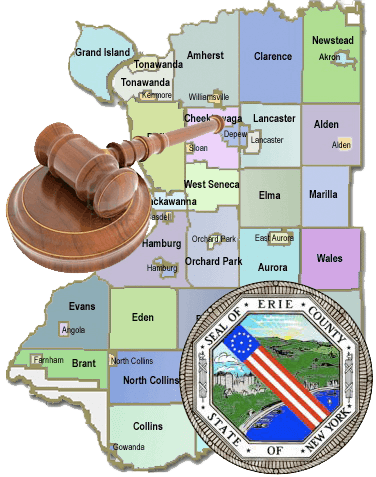
If your DWI case is going to be heard in the Amherst Town Court, you are headed into one of the busiest local courts in all of Western New York, a far cry from the quiet, part-time village courts found out in the county. Amherst is among the largest and most densely populated suburbs in the Buffalo area, and its town court carries a DWI caseload to match. Bakshi & Leta know this court well: our office is right here in Williamsville, inside the Town of Amherst, and we appear in this courtroom regularly.
The Town of Amherst spans the northern suburbs of Buffalo, taking in Williamsville, Snyder, Eggertsville, and Getzville, and it is crossed by some of the region’s heaviest-traveled roads. With that population and traffic comes consistent DWI enforcement and a court calendar that moves at a very different tempo from the small justice courts elsewhere in Erie County. Knowing how this high-volume court operates is the first step toward protecting your license and your record.
A high-volume court, not a sleepy village docket
The contrast is worth stating plainly. A small village justice court out in rural Erie County might sit a couple of evenings a month and hear a short list of cases. The Amherst Town Court is the opposite end of the spectrum: a busy, full calendar serving a town of well over one hundred thousand residents, with a steady stream of DWI matters moving through it. That volume cuts both ways. On one hand, the court and the prosecution are deeply experienced and the docket keeps moving; on the other, an individual case can get lost in the shuffle without an attorney who keeps it front and center. We make sure your case is handled with attention, not processed as just another file.
The roads where Amherst DWI stops begin
Few towns in the region carry as much traffic as Amherst, and its road network is a map of where DWI stops tend to happen. The I-290 corridor moves a constant flow of vehicles across the northern suburbs and is a frequent site of enforcement. Sheridan Drive and Niagara Falls Boulevard are dense commercial strips lined with restaurants and bars, while Maple Road and Transit Road carry heavy evening and weekend traffic. A stop on any of these can start with something minor, such as a lane drift, a speed check, or a brake light, before escalating into roadside field sobriety tests and a chemical test. Layered on top of all this is the University at Buffalo North Campus, which sits in Amherst and brings substantial student and nightlife traffic, particularly on weekends and during the school year.
How the Amherst Town Court fits into New York’s system
For all its size, the Amherst Town Court is still a town justice court under the same New York framework that governs the smallest village court. It is authorized to hear misdemeanor DWI charges, it is run by town justices, and it applies the identical DWI and DWAI statutes used everywhere in the state. Your case will proceed through the familiar stages: arraignment, the exchange of discovery, pretrial motions challenging the stop or the chemical test, conferences with the prosecution, and, if no fair resolution is reached, a hearing or trial. What sets Amherst apart is not the law but the scale and pace at which it all unfolds.
What a busy calendar means for your defense
It is tempting to assume that a high-volume court is bad for a defendant, that a packed docket means cases are rushed and individual circumstances ignored. The reality is more nuanced. A court that handles a large number of DWI cases is also a court whose prosecution and judges are seasoned in exactly these matters, where established procedures move things along and where there are well-worn paths to resolution that a smaller court may rarely travel. The risk is not that the system is hostile; it is that an unrepresented or poorly represented defendant becomes a number, processed efficiently toward whatever outcome requires the least friction. Skilled, prepared counsel changes that dynamic by making sure your case is evaluated on its own facts and that every avenue for a favorable result is pursued rather than overlooked in the volume.
Your license at the first appearance
The first court date is the arraignment, where the charges are read and the court turns to your driving privileges. In a DWI case, a suspension is commonly imposed at this stage, which is exactly why acting quickly matters. We move to secure hardship privileges and, where you are eligible, a conditional license, so that you can keep getting to work, to school, and to medical appointments while the case is pending. In a town the size of Amherst, where daily life depends on a car, protecting your ability to drive is often the most pressing concern.
DWI, DWAI, and why the charge label matters
One point trips up almost everyone: the exact charge on the paperwork matters. New York charges Driving While Intoxicated (DWI), a crime generally brought at a blood-alcohol content of 0.08% or higher, and Driving While Ability Impaired (DWAI), a traffic infraction typically charged between 0.05% and 0.07%. A reading of 0.18% or above is charged as Aggravated DWI, with steeper penalties, and impairment by drugs is charged as DWAI–Drugs. That difference is enormous: securing a reduction from a DWI to a DWAI can turn a criminal conviction into a traffic infraction. In a busy court that handles a high volume of these cases, having counsel who knows how to push for that kind of outcome is what separates one result from another.
Why a nearby, experienced firm makes the difference
Bakshi & Leta are based at 5662 Main St. in Williamsville, within the Town of Amherst, and this is a court we are in routinely. That familiarity (with how the Amherst court runs its calendar, how its prosecution evaluates a borderline test, and what the court expects of a defendant) lets us guide a case efficiently and avoid the missteps that bog matters down. Sunil Bakshi and Joseph Leta have defended DWI cases across Erie County for years, and being right in the community we serve means we are close at hand throughout your case.
We also keep you informed from the start. Beginning the day after your arrest, we explain what each step means, what the court is likely to do, and what your realistic options are, so you are never left guessing in a courthouse that can feel impersonal because of its size.
The added stakes for students and professionals
Amherst’s population is not only large but varied, and a DWI can land on people for whom the stakes reach well beyond the courtroom. The presence of the University at Buffalo North Campus means students are a regular part of the Amherst court’s DWI docket, and for a young person a conviction can ripple outward, into insurance that becomes expensive for years, into a permanent record that surfaces in background checks, and potentially into a university’s own disciplinary processes. At the same time, Amherst is home to many professionals whose careers depend on a clean record or an unrestricted license: healthcare workers, commercial drivers, and others for whom a conviction carries occupational consequences. We take the time to understand what a DWI specifically threatens in your life, because the right strategy for a nursing student is not necessarily the right strategy for a delivery driver, and the goal is always to protect what matters most to you.
Knowing the community we practice in
There is a real advantage to being defended by a firm that lives where you do. Because our office is in Williamsville, in the heart of the Town of Amherst, the roads in these cases are roads we travel ourselves, and the court is one we are in routinely rather than occasionally. That local grounding shapes how we approach a case: we understand the patterns of enforcement along corridors like Niagara Falls Boulevard and Maple Road, we know the practical rhythms of the Amherst Town Court, and we are physically close at hand when you need to meet, ask a question, or appear. For a charge as consequential as a DWI, having an experienced defense team rooted in your own community, not a distant firm parachuting in for a single date, is a meaningful reassurance.
Amherst court questions
Frequently asked questions
Call (716) 631-0004 for answers specific to your case.
Amherst is one of the most populated suburbs in Western New York, and its town court carries one of the heaviest caseloads of any local court in the region. Major roads like I-290, Sheridan Drive, Niagara Falls Boulevard, and Transit Road generate steady traffic enforcement, and the University at Buffalo North Campus adds student and nightlife traffic. The result is a fuller calendar and a faster-moving docket than a small village court.
Yes. Our office is at 5662 Main St. in Williamsville, which sits within the Town of Amherst, so this is a court we practice in regularly and a community we know well. Sunil Bakshi and Joseph Leta are familiar with how the Amherst court manages its high-volume DWI calendar, which helps us move a case forward without unnecessary delay.
DWI (Driving While Intoxicated) is a crime generally charged at 0.08% BAC or higher. DWAI by alcohol is a traffic infraction typically charged between 0.05% and 0.07%, and a BAC of 0.18% or above is charged as Aggravated DWI. New York uses DWI and DWAI, and a reduction from a DWI to a DWAI can mean a traffic infraction rather than a criminal conviction.
A DWI arrest near the University at Buffalo North Campus is handled in the Amherst Town Court like any other, but a conviction can carry added consequences for a student, including effects on a license, on insurance, and potentially on the university’s own processes. Call us as early as possible so we can protect your driving privileges and advise you on the full picture before anything is decided.
DWI case in Amherst Town Court? Call now.
The sooner you call, the more we can do to protect your license and your record. Free, confidential consultation.