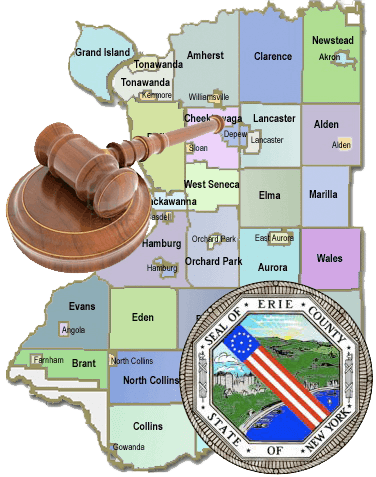
Out at the far southwest edge of Erie County, where the lakeshore meets the Chautauqua County line, the Town of Brant runs a small justice court that hears the cases arising on its roads, and on the busy highways that pass through it. If you are facing a DWI that will be decided in the Brant Town Court, you want counsel who already knows these outlying courts. Bakshi & Leta have appeared in the rural town courts at the corners of Erie County for decades, and we understand how a charge moves through a court like Brant’s.
Brant is a quiet, rural town, but its position on the map gives it an outsized share of through traffic. Route 5 hugs the lake, the New York State Thruway runs nearby, and travelers from far beyond the county roll through on both. That mix, a small local court handling cases generated by long-distance highway traffic, gives DWI defense here a particular character, and it pays to understand it from the outset.
What a small lakeshore town justice court is like
Under New York law, towns operate their own justice courts with authority over a broad slate of matters, misdemeanor DWI charges among them. The Brant Town Justice Court is one of these courts, presided over by a town justice and sitting on a part-time calendar rather than the daily schedule of a busy urban court. Appearances may be spaced apart, and a case can take time to move through arraignment, the exchange of discovery, pretrial motions, and a final disposition.
Because Brant is small and remote, scheduling and logistics matter even more than usual. A defendant who lives out of town, or out of state, should not have to make repeated long drives back to the lakeshore for every routine appearance. We handle as much of that as the court allows, appearing on your behalf where permitted so the burden of distance does not compound the stress of the charge.
The Thruway, Route 5, and where Brant DWI stops begin
Enforcement in Brant follows the roads, and the roads here carry traffic moving long distances. Route 5 runs along the lake through the town and the neighboring hamlet of Farnham, a steady route for both local drivers and travelers tracing the shoreline. Brant-Farnham Road links the interior of the town to that corridor. And the New York State Thruway, Interstate 90, passes near Brant with an interchange in the area, funneling cross-state and interstate traffic right past the town’s doorstep.
Highway stops add their own wrinkles to a DWI case. A driver covering long miles on the Thruway or Route 5 may be fatigued, unfamiliar with the area, or simply driving at highway speed when an officer initiates a stop for speed or a minor lane deviation. The conditions of a highway stop (the speed, the noise, the roadside shoulder where field tests are administered) all become part of the record, and all are fair ground for examination. We dig into how and why each Brant stop happened, because the answers often shape what comes next.
The anatomy of a DWI charge
Every DWI case rests on a chain of events: the initial stop, the officer’s observations, the standardized field sobriety tests, and the chemical test of breath or blood. Each link must hold up under scrutiny. Was there a valid reason to stop you on Route 5 or the Thruway? Were the roadside tests given properly? Was the breath instrument calibrated and maintained, and was the operator certified? When one of those links is weak, the whole case can be challenged, and identifying those weaknesses is the foundation of a real defense.
How New York labels these charges: DWI vs. DWAI
New York divides impaired driving into two separate offenses, and the line between them carries real weight. Driving While Intoxicated (DWI) is the criminal charge, typically filed at a blood-alcohol level of 0.08% or above, while Driving While Ability Impaired (DWAI) is merely a traffic infraction, usually reserved for readings of 0.05% to 0.07%. A blood-alcohol level of 0.18% or more bumps the case up to Aggravated DWI and its stiffer penalties, and a driver impaired by drugs faces a DWAI–Drugs charge instead. The gap between these categories is enormous in practice: a reduction from a DWI to a DWAI can turn a criminal conviction into a non-criminal traffic infraction, and working toward that kind of outcome is often where a defense earns its keep.
Acting early to protect your license
The arraignment is your first appearance, where the charges are read and the court takes up your driving privileges. In most DWI cases the court suspends your license at that stage. Because Brant is so far from the population centers and many drivers here are simply passing through, the loss of driving privileges can be especially disruptive. We move promptly to seek hardship privileges and, where you qualify, a conditional license, so you can keep meeting your obligations while the case proceeds.
The consequences a Brant DWI can carry
A DWI conviction in New York reaches far beyond a single court date. Alongside fines and the mandatory state surcharges, a conviction commonly brings a license revocation, enrollment in the Impaired Driver Program, and an ignition interlock requirement on any vehicle the driver operates. For travelers who pass through Brant on Route 5 or the Thruway, an additional complication looms: New York reports convictions to other states through the interstate Driver License Compact, so a DWI handled in a small Erie County town court can follow a driver home and affect a license issued elsewhere. Prior convictions within the statutory lookback period can also raise the level of the charge and sharpen the penalties. We map out these exposures at the start of every case so you understand precisely what is at stake and why the fight over a reduction or dismissal matters.
That is also why the distinction between a DWI and a DWAI is so consequential here. Securing a reduction from a criminal DWI to a non-criminal DWAI can spare a driver the harshest of these collateral effects, and pursuing that result, where the facts and the law support it, is frequently at the center of how we defend a Brant case.
Building a defense in a highway-stop case
Cases that originate on Route 5 or the Thruway turn heavily on the details of how the stop unfolded, and that is where we focus. We gather the trooper’s or officer’s reports, any dashboard or body-worn video, and the maintenance and calibration records for the breath instrument, then test each piece against the standards the law imposes. A driver covering long distances may have been tired, unfamiliar with the road, or reacting to highway conditions rather than alcohol, and those facts can reframe what an officer characterized as impaired driving. Where the chemical evidence is questionable, or where the stop itself rested on a thin justification, we are prepared to challenge it. And because so many Brant defendants live far from the courthouse, we work to handle routine appearances on your behalf wherever the court permits, so distance never forces you to choose between your defense and your daily life.
Why experience in the outlying courts matters
Courts at the edges of the county have their own rhythms, and knowing them makes a difference. Understanding how a particular town court sets its calendar, how its prosecutor sizes up a close test, and what the bench expects lets us guide a case efficiently and avoid missteps that stretch matters out. Sunil Bakshi and Joseph Leta have appeared in the rural and lakeshore justice courts of Erie County for years, and we bring that practical familiarity to every Brant Town Court case, while keeping you informed and unsurprised at each turn.
Brant court questions
Frequently asked questions
Call (716) 631-0004 for answers specific to your case.
It depends on exactly where the stop happened. A DWI charged on a local Brant road such as Route 5 or Brant-Farnham Road is generally filed in the Brant Town Justice Court. A stop on the New York State Thruway is handled by the local justice court for the town where the milepost falls, which can be Brant or an adjacent town. We pin down the correct court before your first date.
Brant sits in the far southwest corner of Erie County on the lakeshore, close to the Chautauqua County line. The distance does not change the law, but it does mean stops often involve long-distance Route 5 and Thruway travelers passing through. We appear in these outlying town courts regularly, so the location is no obstacle to mounting a full defense.
DWI (Driving While Intoxicated) is a crime generally charged at 0.08% BAC or higher. DWAI (Driving While Ability Impaired by alcohol) is a traffic infraction typically charged between 0.05% and 0.07%. Aggravated DWI applies at 0.18% or higher. The difference matters: a reduction from DWI to DWAI can turn a crime into a mere infraction.
Yes. Because the Thruway and Route 5 carry travelers from outside New York, many Brant-area DWI cases involve out-of-state drivers. We can often appear on your behalf at routine dates so you are not making repeated long trips back to the Town of Brant, while still protecting your driving privileges and your record.
DWI case in Brant Town Court? Call now.
The sooner you call, the more we can do to protect your license and your record. Free, confidential consultation.