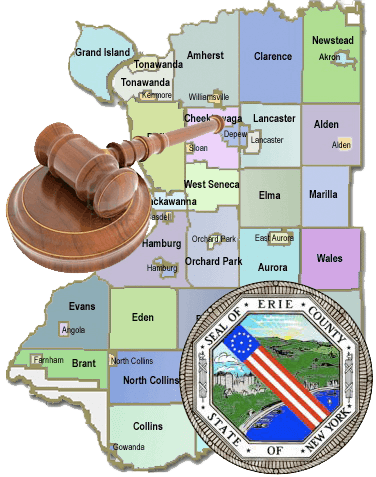
A DWI case bound for the Cheektowaga Town Court lands in one of the busiest justice courts in Erie County. Cheektowaga is a sprawling, heavily traveled suburb, built around the Thruway, the airport, and the Walden Galleria, and its town court carries a docket to match. Bakshi & Leta have appeared in that courtroom and the other high-volume suburban courts around Buffalo for decades, and we know how a charge moves through a calendar this full.
That volume changes how a case feels from the inside. A court that hears DWI matters week in and week out runs on a brisk, settled routine, and that cuts both ways: things can move quickly, and a defendant without experienced counsel can feel swept along. Our job is to slow the part that matters (the scrutiny of the stop, the testing, and the negotiation) while keeping the rest of the case moving on schedule.
A high-volume court built around the Thruway and the airport
The Town of Cheektowaga sits directly east of the City of Buffalo and is home to the Buffalo Niagara International Airport. The New York State Thruway (Interstate 90) cuts through the town, and the Walden Galleria draws shoppers, diners, and travelers from across the region every day. All of that activity feeds the Cheektowaga Town Court, which under New York’s justice-court system has authority to hear misdemeanor DWI charges along with a broad range of other criminal and traffic matters. Because the surrounding roads are so heavily used, the court’s DWI calendar is fuller than what you would find in a quiet village court, and cases tend to be processed at a steadier pace.
Where you were physically stopped still decides which court hears your case. A traffic stop inside the Town of Cheektowaga, including much of the airport corridor and the Galleria area, is generally filed in the Cheektowaga Town Court, while a stop a few hundred feet over the city line routes to Buffalo City Court instead. Those boundaries are invisible from behind the wheel, so one of our first steps is confirming exactly which court holds your case.
The roads where Cheektowaga DWI stops begin
Few towns in Erie County see the kind of through-traffic Cheektowaga does. The Thruway alone carries a constant flow of long-distance and commuter traffic, and its interchanges put state police and local patrols in regular contact with drivers leaving the area at night. Walden Avenue is the town’s commercial spine, lined with the Galleria, restaurants, and retail that keep it busy well into the evening. Genesee Street runs east from the airport and the city, and Union Road ties the town’s neighborhoods to its shopping and dining districts. Each of these corridors carries the late-night and post-dinner traffic where DWI enforcement concentrates.
An arrest near the Galleria or off a Thruway ramp usually starts with an ordinary observation: a wide turn out of a parking lot, a brake light, a brief drift between lanes. From there, the officer’s notes, the roadside field sobriety tests, and the chemical breath or blood test become the foundation of the prosecution’s case. Every one of those steps is bound by rules, and every one is a place where a close look can reveal a weakness worth pressing.
What a fuller court calendar means for your case
Your first court date is the arraignment, where the charges are formally read and the court takes up your driving privileges. In a DWI case those privileges are commonly suspended at this stage, which is why acting fast is so important: we move to secure hardship privileges and, where you qualify, a conditional license so you can keep getting to work, school, and medical appointments while the case is open. In a town as commuter-heavy as Cheektowaga, losing the ability to drive is not a minor inconvenience. It can put a job at risk.
From there, a Cheektowaga case proceeds through the familiar stages of a New York DWI: the exchange of discovery, pretrial motions challenging the stop or the test, conferences with the prosecution, and, if no fair resolution emerges, a hearing or trial. The difference here is tempo. A busy court resolves a steady stream of cases, and that can work in your favor when the defense is prepared and ready to negotiate, or against you if a case is left to drift. We keep yours organized and moving toward the best available outcome.
Building a defense from the traffic stop forward
A DWI charge can look airtight to the person staring at the paperwork, but a charge is not a conviction. The prosecution still has to prove its case, and that case is assembled from a chain of steps that each have to hold up. Was there a lawful reason for the stop in the first place? On a corridor like Walden Avenue or a Thruway off-ramp, an officer needs a genuine basis to pull a driver over, and a stop built on a vague hunch can be challenged. Were the field sobriety tests administered properly, on level ground, with correct instructions? Roadside tests done in a sloping parking lot or on a cold, windy shoulder are far less reliable than the report may suggest.
The chemical test invites its own scrutiny. Breath-testing instruments must be properly maintained, calibrated, and operated by a certified person, and the law requires specific observation periods before a sample is taken. Medical conditions, mouth alcohol, and timing can all skew a reading. We request and review the records behind the test in every case, because a number that looks decisive on a charging document sometimes rests on a procedure that did not follow the rules. Those are the pressure points that can lead to suppressed evidence, a reduced charge, or a stronger negotiating position.
The penalties and DMV consequences at stake
A DWI in New York reaches well beyond the courtroom. A conviction can bring fines, a mandatory state surcharge, possible jail exposure, a period of license revocation, and enrollment in the Impaired Driver Program, and most DWI convictions require an ignition interlock device on any vehicle you own or operate. The Department of Motor Vehicles imposes its own consequences separate from the criminal case, including driver-responsibility assessments and, for repeat offenses, far longer revocations. For a Cheektowaga resident who commutes on the Thruway or relies on a car to reach a job near the airport or the Galleria, those licensing penalties can be the most disruptive part of the whole ordeal. Understanding the full picture, criminal and administrative alike, is exactly why a careful, locally experienced defense matters from day one.
DWI, DWAI, and Aggravated DWI in New York
New York sorts impaired-driving charges by what the evidence shows, and the label on your ticket shapes everything that follows. The state charges Driving While Intoxicated (DWI), a crime generally brought at a blood-alcohol content of 0.08% or higher, and Driving While Ability Impaired (DWAI), a traffic infraction typically charged between 0.05% and 0.07%. A BAC of 0.18% or higher becomes Aggravated DWI, which carries heavier penalties, and impairment by drugs is charged as DWAI–Drugs. The labels matter a great deal, because a reduction from a DWI to a DWAI can be the line between a criminal conviction and a mere traffic infraction. Steering a case toward that kind of result is frequently the central goal of the defense.
Why experience in busy suburban courts pays off
High-volume courts reward preparation and familiarity. Knowing how a court like Cheektowaga’s sequences its calendar, how its prosecutors weigh a borderline breath reading, and what the court expects from the parties lets us move a case efficiently rather than getting lost in the crowd of a packed docket. Sunil Bakshi and Joseph Leta have practiced for years throughout the town and city courts of Erie County, and we bring that hands-on knowledge to every Cheektowaga case.
We also keep you informed at every turn. From the day after your arrest, we explain what each appearance means, what the court is likely to do, and what your realistic options are. A DWI is unsettling on its own; you should never have to face it without a clear picture of where your case stands.
Cheektowaga court questions
Frequently asked questions
Call (716) 631-0004 for answers specific to your case.
Cheektowaga is a large, busy suburb wrapped around the Thruway, the Walden Galleria, and the Buffalo Niagara International Airport, so its town justice court carries one of the fuller DWI calendars in Erie County. A heavier docket means the court moves cases at a brisker clip than a small rural court, and having counsel who knows that pace helps your case stay on track.
It depends on exactly where the stop occurred. Arrests within the Town of Cheektowaga, including much of the airport and Galleria area, are generally filed in the Cheektowaga Town Court, while a stop just over the line in the City of Buffalo would go to Buffalo City Court. We confirm which court holds your case before your first appearance.
DWI (Driving While Intoxicated) is a crime generally charged at 0.08% BAC or higher. DWAI (Driving While Ability Impaired by alcohol) is a traffic infraction typically charged between 0.05% and 0.07%, and a BAC of 0.18% or higher is charged as Aggravated DWI. The distinction carries real weight, because a reduction from DWI to DWAI can keep a conviction off your criminal record.
In many misdemeanor DWI cases your attorney can stand in for you at routine appearances, although the court may require you at arraignment or for certain proceedings. Because Cheektowaga draws so many commuters and travelers, we work to schedule efficiently and tell you exactly which dates need you in person.
DWI case in Cheektowaga Town Court? Call now.
The sooner you call, the more we can do to protect your license and your record. Free, confidential consultation.