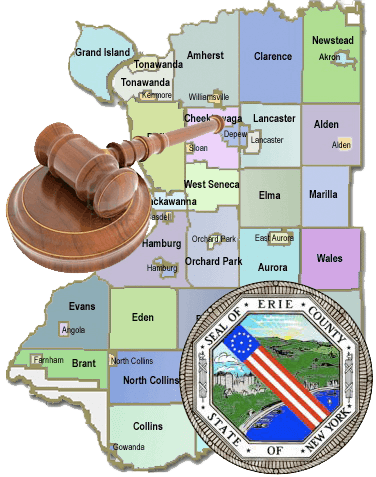
If you were stopped for drinking and driving anywhere in the Town of Concord, your case is almost certainly headed to the Concord Town Court in Springville. A charge that begins on Route 219 coming down from the Southern Tier, or on Main Street in the village on a Friday night, can feel overwhelming when you have never set foot in a courtroom. Sunil Bakshi and Joseph Leta defend DWI and DWAI cases throughout the rural justice courts of southern Erie County, and they know how a town court like Concord’s actually works.
Concord sits at the southern edge of Erie County, the gateway to Western New York’s ski country. Traffic swells in winter as visitors head to the slopes and in summer as the area’s festivals draw crowds. That mix of through-traffic and local roads means enforcement here is steady, and a single stop can put a person who has never had so much as a parking ticket in front of a town justice. Understanding what comes next is the first step toward protecting your license and your record.
How a town justice court operates
New York’s town and village justice courts are the oldest part of the state’s court system, and they function differently from the city courts most people picture. The Concord Town Court is presided over by a locally elected town justice rather than a full-time judge, and court is held on scheduled evenings rather than every weekday. The docket on a given night can include traffic infractions, small claims, local ordinance matters, and criminal cases all in the same session. A DWI is one of the more serious matters that court will hear, and it is prosecuted by the Erie County District Attorney’s Office.
Because these courts sit less frequently and handle a broad mix of business, the rhythm of a case can be slower and more personal than in a busy urban court. That can work in a defendant’s favor (there is often room for a measured, well-prepared defense), but it also means knowing the local procedure matters. An attorney who regularly appears in southern Erie County courts understands how scheduling, motion practice, and plea discussions tend to unfold in a setting like Concord.
DWI and DWAI: what New York actually charges
New York’s Vehicle and Traffic Law charges Driving While Intoxicated and several grades of Driving While Ability Impaired. The distinctions carry real weight:
- DWI is a crime, generally charged at a blood-alcohol content of 0.08% or higher, or based on an officer’s observations of impairment.
- DWAI–Alcohol is a traffic infraction, typically charged between 0.05% and 0.07%, and is frequently the goal of a negotiated resolution.
- Aggravated DWI applies at 0.18% or higher and carries enhanced penalties.
- DWAI–Drugs or combined drug-and-alcohol impairment is charged when a substance other than alcohol is involved.
A first DWI is usually a misdemeanor, but a second within ten years can be charged as a felony. Knowing which charge you actually face, and which charge the evidence can truly support, shapes every decision that follows.
Where stops happen around Concord
The geography of the town tells you a great deal about where DWI stops tend to originate. Route 219 is the high-speed corridor that carries traffic between Buffalo’s southern suburbs and the Southern Tier, and the stretches near the Springville exits see regular patrol. Route 39 runs east-west through the heart of town and connects the village to neighboring communities, while Main Street is the village’s commercial spine where evening traffic concentrates. Seasonal enforcement around the ski-country routes adds another layer in winter. None of this changes the law, but it does mean that the circumstances of a stop (the road, the conditions, the stated reason for pulling a driver over) deserve close scrutiny in a place like Concord.
What we examine in a Concord DWI case
Every DWI case is built on a sequence of steps, and each step is a place where the prosecution’s case can be challenged. We start by asking whether the initial stop was lawful: did the officer have a valid reason to pull you over in the first place? From there we look at the roadside field sobriety tests, which are subjective by nature and easily affected by cold weather, uneven shoulders along a rural road, footwear, fatigue, and ordinary nervousness.
The chemical test is frequently the centerpiece of the case, and breath-testing instruments must be properly calibrated, maintained, and operated by a certified operator. We obtain and review the maintenance and calibration records and the testing protocol for any deviation that could undermine the reliability of the result. If you refused the chemical test, you also face a separate DMV refusal proceeding with its own one-year revocation, entirely apart from what happens in the Concord Town Court. It is a process we have handled many times.
Decades of experience in courts like Concord’s
Bakshi & Leta have spent more than 25 years defending DWI and DWAI cases across the many town and village courts of Erie and Niagara Counties. Each justice has particular expectations, and our familiarity with how these smaller courts operate lets us resolve cases efficiently while protecting what matters most to our clients. We explain every issue as it arises, so you are never left guessing about what is happening or why.
For many of our clients, the most pressing worry is simply being able to keep driving (to get to work, to bring children to school, to make medical appointments) in a part of the county where distances are long and public transit is scarce. Acting quickly after an arrest gives us the best opportunity to secure hardship and conditional driving privileges while we work toward the strongest possible outcome.
If you are facing a DWI in the Concord Town Court, do not navigate it alone. Call Bakshi & Leta today at (716) 631-0004 for a free, confidential consultation, and learn more about every community we represent on our areas we serve page.
Concord court questions
Frequently asked questions
Call (716) 631-0004 for answers specific to your case.
A DWI charged in the Town of Concord, which includes the Village of Springville, is generally handled by the Concord Town Court, a local justice court in Erie County. A town justice presides, and the Erie County District Attorney’s Office prosecutes.
New York charges Driving While Intoxicated (DWI) and Driving While Ability Impaired (DWAI). DWI is a crime, generally charged at a blood-alcohol content of 0.08% or higher. DWAI–Alcohol is a traffic infraction, typically charged between 0.05% and 0.07%, and is frequently the goal of a negotiated resolution.
You must appear at arraignment, but once we are retained we handle most subsequent court dates on your behalf. For many routine appearances in a town justice court your attorney can stand in, sparing you repeated trips to Springville.
Often yes. Although your license is typically suspended at arraignment, we can frequently obtain a hardship privilege and later a conditional license so you can continue commuting along Route 39, Route 219, and to work while the case is pending.
Charged with DWI in Concord? Call now.
The sooner you call, the more we can do to protect your license and your record in the Concord Town Court. Free, confidential consultation.