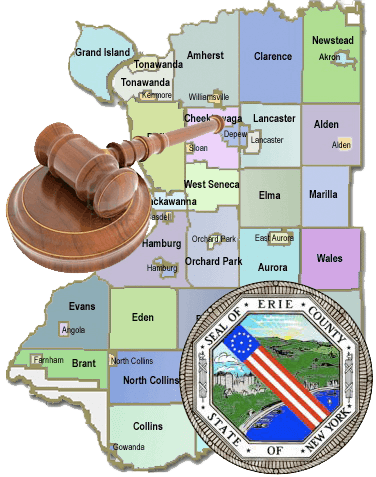
The Town of Elma occupies a distinctive spot in Erie County: a semi-rural community split down the middle by Route 400 (the Aurora Expressway), the high-speed link between the southern towns and the Buffalo metro area. A DWI charge arising in Elma is heard in the Elma Town Court, and a great many of those charges begin on the expressway itself. Sunil Bakshi and Joseph Leta have spent decades defending DWI and DWAI cases in the justice courts of Erie County, including the highway-corridor cases that are common in a town like Elma.
What sets Elma apart from many of its neighbors is precisely that expressway running through it. Route 400 funnels a heavy stream of fast-moving traffic between East Aurora, Orchard Park, and Buffalo, and stops on a limited-access highway raise questions you simply do not encounter on a village side street. If you have been charged after a stop in Elma, understanding both the court and the unique character of a highway DWI is the place to start.
Inside the Elma Town Court
Elma, like nearly every New York town, operates its own town justice court. It is a court of limited jurisdiction that hears traffic infractions, town code violations, civil matters, and criminal cases, with DWI among the more serious matters on its docket. A locally elected town justice presides on scheduled court dates, and the Erie County District Attorney’s Office prosecutes the alcohol-related driving charges on behalf of the People of the State of New York.
The town-court setting shapes how a case unfolds. Court is held on particular evenings rather than every weekday, the calendar mixes many kinds of cases, and the proceedings are often more personal than those in a high-volume city court. For a defendant, that environment can leave room for a careful, well-prepared defense, provided the attorney understands how Erie County’s town courts actually operate and what a given justice expects.
The charges New York actually brings
New York’s Vehicle and Traffic Law sets out several distinct alcohol and drug related driving charges, and which one you face shapes everything that follows. What the state charges are:
- DWI (Driving While Intoxicated), a crime, generally at 0.08% BAC or higher, or established through observed impairment.
- DWAI–Alcohol, a traffic infraction, generally between 0.05% and 0.07% BAC, often the goal of a negotiated outcome.
- Aggravated DWI, a BAC of 0.18% or higher, with stiffer penalties.
- DWAI–Drugs or combined, impairment by drugs, alone or together with alcohol.
A first DWI is usually a misdemeanor; a prior within ten years can make a new charge a felony. These are meaningful distinctions, and the difference between them often comes down to the evidence and the advocacy brought to bear in court.
Route 400 and the geography of Elma stops
Elma’s defining feature for DWI purposes is Route 400. The Aurora Expressway carries fast, steady traffic and is patrolled by both town and state law enforcement, and a substantial share of Elma DWI stops originate there. Off the expressway, Bowen Road, Bullis Road, and Jamison Road form the local grid, connecting Elma’s hamlets and carrying traffic to and from the surrounding towns. A highway stop raises its own set of issues: the articulated reason for pulling a driver over at speed, where the vehicle was brought to a stop, and whether the roadside testing could be safely and properly conducted alongside a busy expressway. Those questions are central to how we approach an Elma case.
How we challenge the prosecution’s case
A DWI case is a sequence of steps, and we examine every one. It begins with the stop itself: the officer must have had a lawful basis to pull you over, and on a highway that basis is often a key battleground. From there we look at the field sobriety tests. These tests are subjective and can be compromised by the conditions in which they are given. The noise and vibration of passing traffic, an uneven highway shoulder, weather, footwear, and ordinary nervousness all undermine their reliability.
The chemical test is frequently the prosecution’s centerpiece, and breath instruments must be properly calibrated, maintained, and operated by a certified operator following the correct protocol. We obtain and review those records, searching for any deviation that could call the result into doubt. And if you refused the test, you face a separate DMV refusal hearing with its own one-year revocation, independent of the Elma court case. It is a proceeding we have handled countless times and one that must be addressed promptly.
Decades of DWI defense across Erie County
For more than 25 years, Bakshi & Leta have appeared in the town and village justice courts throughout Erie and Niagara Counties. Each justice has particular requirements, and our familiarity with how these courts work, including the highway-corridor cases that arise in towns like Elma, allows us to resolve matters efficiently while protecting our clients’ licenses and records. We make a point of explaining each issue as it comes up, so you always understand where your case stands.
For most of our clients, the immediate fear is losing the ability to drive, a serious problem in a town where Route 400 and a few local roads are the only way to get anywhere. Reaching out quickly after an arrest gives us the best chance to obtain hardship and conditional driving privileges while we work toward the strongest possible resolution.
If you are facing a DWI in the Elma Town Court, call Bakshi & Leta today at (716) 631-0004 for a free, confidential consultation. See every community we represent on our areas we serve page.
Elma court questions
Frequently asked questions
Call (716) 631-0004 for answers specific to your case.
A DWI stop on Route 400 (the Aurora Expressway) within the Town of Elma is generally handled by the Elma Town Court, a local justice court in Erie County. A town justice presides and the Erie County District Attorney’s Office prosecutes.
The charge is the same, but a stop on a limited-access highway like Route 400 raises specific questions: the basis for the stop, the speed and traffic conditions, and where the field testing was conducted. We scrutinize each of these in an Elma case.
DWI (Driving While Intoxicated) is a crime, generally charged at 0.08% BAC or higher. DWAI (Driving While Ability Impaired) is a traffic infraction, generally between 0.05% and 0.07% BAC, and it is often the goal of a negotiated outcome. Your defense turns on the specific New York charge.
Your license is typically suspended at arraignment, but a suspension is not necessarily the end of your ability to drive. We can frequently obtain a hardship privilege and then a conditional license so you can continue commuting on Route 400, Bowen Road, and your other routes.
Charged with DWI in Elma? Call now.
The sooner you call, the more we can do to protect your license and your record in the Elma Town Court. Free, confidential consultation.