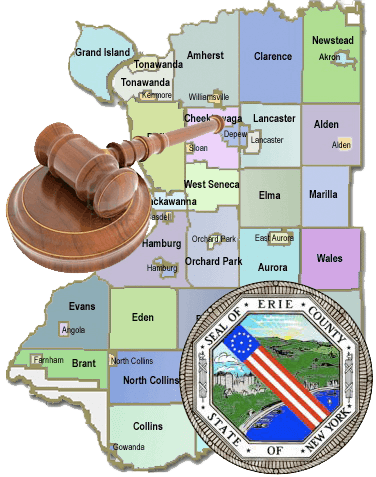
Marilla is one of the quietest corners of Erie County, a small, rural town of farms, woods, and country roads southeast of Buffalo. It is exactly the kind of place where a driver can be stopped late at night on a dark two-lane road and suddenly find themselves charged with Driving While Intoxicated. If your DWI is returnable in the Marilla Town Court, Sunil Bakshi and Joseph Leta can help you understand what comes next and protect what matters most.
Most people who walk into a town justice court for the first time have never been in any kind of trouble before. The setting can be deceptively informal (a town hall, a part-time justice, a court that sits only certain evenings of the month), but the charge itself is fully serious, and the consequences attach under the same New York law that governs a case in downtown Buffalo. Understanding that distinction, and having counsel who knows how these small courts actually operate, makes a real difference.
How the Marilla Town Court works
Like every town in New York, Marilla operates its own justice court staffed by elected town justices rather than full-time judges. These courts handle traffic infractions, violations, misdemeanors, and the early stages of felony cases arising within the town’s borders. A town court typically convenes only on scheduled evenings, which means dates are spaced out and the calendar moves at its own pace. For a defendant, that can be an advantage: there is often room to gather records, file motions, and negotiate without the crush of a busy urban docket.
Because Marilla is a small, rural community, the volume of cases is comparatively low and the proceedings are personal. The prosecutor, the court clerk, and the justice are people we encounter throughout Erie County’s town and village courts. Knowing how a particular court prefers matters to be presented (what it expects at arraignment, how it handles conditional licenses, when it is receptive to a reduction) is the kind of practical knowledge that comes only from years of appearing in courts exactly like this one.
Where Marilla DWI stops happen
Enforcement in a rural town tends to concentrate on the through-roads that carry traffic across the county. In Marilla, that means Two Rod Road, Clinton Street, and Bullis Road (the main routes connecting the town to neighboring Wales, Elma, and Lancaster). State Police troopers and Erie County Sheriff’s deputies patrol these roads heavily on weekend nights, and a stop can begin with something as minor as a plate-light out, a missed stop sign at an unlit rural intersection, or drifting over the center line on a narrow shoulder.
The reason for the stop matters enormously. Under both the United States and New York constitutions, an officer must have a lawful, articulable basis to pull a vehicle over. When we take a Marilla case, one of our first steps is to scrutinize that initial stop. If the officer lacked a legitimate reason, the evidence that followed (the roadside observations, the field tests, the chemical result) may be subject to suppression, which can dramatically reshape or even end the prosecution.
DWI, DWAI, and how New York charges impaired driving
The charge you are facing will read either DWI (Driving While Intoxicated) or DWAI (Driving While Ability Impaired), and the difference between the two matters a great deal. A standard DWI is generally charged at a blood-alcohol content of 0.08% or higher and is a misdemeanor for a first offense, carrying a minimum six-month license revocation and a fine of at least $500. DWAI by alcohol is a traffic infraction, usually charged between 0.05% and 0.07%, and is frequently the goal of a successful negotiation. A BAC of 0.18% or more becomes Aggravated DWI, and a second alcohol-related conviction within ten years can be charged as a felony.
Whatever label appears on your paperwork, the same defense principles apply: was the stop lawful, were the field sobriety tests administered correctly, and was the breath or blood instrument properly calibrated, maintained, and operated by a certified technician? In a small court like Marilla, building a careful, documented challenge on these points is often what separates a conviction from a favorable resolution.
Protecting your license and your record
For a Marilla resident, a suspended license is not a minor inconvenience. Out here, there is no subway and little public transit, and most people depend entirely on driving to reach work, school, and medical care. At arraignment the court will typically suspend your driving privileges, but we can frequently move quickly to secure hardship privileges and, in time, a conditional license so your daily life can continue while your case is pending. If you refused the chemical test, you also face a separate DMV refusal hearing with its own one-year revocation, and we handle that proceeding alongside the court case.
Beyond the license, a DWI conviction can mean an ignition interlock device on every vehicle registered in your name, higher insurance costs, a permanent criminal record, and complications for employment, professional licensing, and travel to nearby Canada. These collateral consequences are often what concern our clients most, and they are a central focus of how we approach every case.
Why drivers across Erie County call Bakshi & Leta
From our office on Main Street in Williamsville, we have defended DWI clients in courts throughout Erie County for decades, including the small rural justice courts of the county’s southern and eastern towns. We know that a case in Marilla calls for a different rhythm than one in a busy city court: more personal, more dependent on relationships and local procedure, and often more open to a thoughtful resolution. We bring that understanding to every appearance.
Just as important, we keep you informed at every stage, from the day after your arrest through arraignment, motions, negotiations, and, if necessary, trial. You will always understand what is happening and why. To see the full range of communities and courts we cover, visit our areas we serve page.
A DWI charged in the Town of Marilla deserves the same serious, experienced defense as any case in Western New York. Call Bakshi & Leta today at (716) 631-0004 for a free, confidential consultation.
Marilla Town Court
Frequently asked questions
Call (716) 631-0004 for answers specific to your case.
A DWI or DWAI issued within the Town of Marilla is generally returnable in the Marilla Town Court, the local justice court for this rural Erie County town. Your appearance ticket lists the date and time you must appear.
No. A town justice court hears the same DWI charges under the same Vehicle and Traffic Law. The penalties, license consequences, and criminal record are identical; the difference is procedural and local.
Once retained, we appear with you and, in many misdemeanor matters, can handle routine appearances on your behalf. We will always tell you which dates require your personal presence.
Rural courts like Marilla sit only limited evenings and are run by part-time justices. Knowing the schedule, the assigned prosecutor, and how that court resolves DWI cases helps move your matter toward the best available outcome.
Charged with DWI in Marilla? Call now.
The sooner you call, the more we can do to protect your license and your record in the Marilla Town Court. Free, confidential consultation.