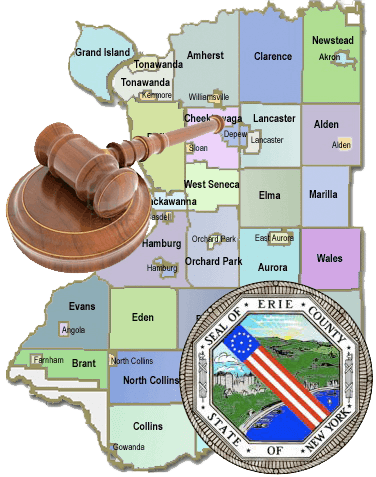
The Town of Tonawanda is one of the largest and busiest suburbs in all of Western New York, a dense ring of neighborhoods, shopping plazas, and major expressways pressed up against the northern edge of Buffalo. With that much traffic and that much patrol activity comes a town court that sees a steady stream of DWI cases every month. If your charge is returnable in the Tonawanda Town Court, Sunil Bakshi and Joseph Leta are ready to step in immediately and guide you through what happens next.
Because Tonawanda is so heavily traveled, a DWI here rarely begins on some quiet country lane. It begins on a six-lane commercial boulevard, an interstate ramp, or a packed weekend artery where police presence is constant. The good news is that the same volume that produces these arrests also produces a court and a prosecutor accustomed to resolving them, and a defense team that appears in this court regularly knows how to use that to a client’s advantage.
A large suburban town with its own justice court
The Town of Tonawanda is not a small rural hamlet; it is a sprawling, densely populated community of tens of thousands of residents that also surrounds the Village of Kenmore. Despite its size, it is still governed in the same way as every other New York town: by its own justice court, presided over by elected town justices rather than full-time judges. That court has jurisdiction over the traffic infractions, violations, misdemeanors, and the opening stages of felony matters that arise within the town’s borders, which makes it one of the higher-volume town courts in Erie County.
One point of confusion deserves a quick word. The Town of Tonawanda in Erie County is a separate jurisdiction from the neighboring City of Tonawanda, which has its own city court, and from North Tonawanda, which sits across the county line in Niagara County entirely. Three places share a similar name, but a charge is heard only in the specific court named on your paperwork. We make certain at the outset that your case is being handled in the right forum, because appearing in the wrong court, or simply missing the right one, creates problems that are entirely avoidable.
Where Town of Tonawanda DWI stops happen
Enforcement here is concentrated on the commercial corridors and expressways that carry enormous daily traffic between Buffalo, the suburbs, and Niagara County. The roads that generate the most DWI stops in the Town of Tonawanda include Sheridan Drive, Niagara Falls Boulevard, Delaware Avenue, Colvin Boulevard, and the I-290 “Youngmann” expressway that cuts across the town. These are some of the most patrolled stretches of road in the entire county, lined with restaurants, bars, and retail, and saturated with police activity on Friday and Saturday nights.
On a road like Sheridan or Niagara Falls Boulevard, a stop can be triggered by almost anything: a momentary lane drift in heavy traffic, a brake light out, a rolling stop at a busy intersection, or a tail-end checkpoint near a known nightlife cluster. The Town of Tonawanda Police, the Erie County Sheriff, and the State Police all work these corridors. Whatever the stated reason, the legality of that initial stop is one of the first things we examine, because everything that follows depends on it.
The expressway cases deserve special mention. Because the I-290 threads directly through the town and connects to the I-190 and the Thruway, many Tonawanda arrests begin with a highway stop: a vehicle clocked for speed, a complaint called in by another driver, or a pull-over on a poorly lit ramp late at night. Highway DWI stops carry their own evidentiary wrinkles, from how speed was measured to whether there was truly a basis to extend a routine stop into a sobriety investigation, and we treat those questions as central to the defense rather than as afterthoughts.
Challenging the stop and the evidence
Under both the United States and New York constitutions, an officer must have a lawful, articulable reason to pull a car over. In a high-traffic environment, that reason is not always as solid as the paperwork suggests; an officer reacting to dense, fast-moving traffic may misjudge a lane position or a following distance. When we take a Tonawanda case, we obtain the dashcam and bodycam footage, the officer’s notes, and the calibration and maintenance records for the breath instrument, and we test each link in the chain.
If the stop itself was unlawful, the roadside observations, the field sobriety tests, and the chemical result that followed may all be subject to suppression, which can dramatically narrow or even end the prosecution. Even where the stop was valid, field sobriety tests must be administered exactly as trained, and the breath or blood instrument must have been properly calibrated, maintained, and operated by a certified technician. In a busy court that processes many of these cases, a carefully documented challenge on these points is frequently what distinguishes a conviction from a favorable resolution.
How New York charges DWI and DWAI
New York’s statutes recognize two core alcohol-related driving charges, and the difference between them matters a great deal in a town court like Tonawanda’s: DWI (Driving While Intoxicated) and DWAI (Driving While Ability Impaired). A standard DWI is generally charged at a blood-alcohol content of 0.08% or higher and is a misdemeanor for a first offense, carrying a minimum six-month license revocation and a fine of at least $500. DWAI by alcohol is a traffic infraction, usually charged between 0.05% and 0.07%, and is often the target of a successful negotiation. A BAC of 0.18% or more is charged as Aggravated DWI, and a second alcohol-related conviction within ten years can be elevated to a felony.
Whichever label appears on your appearance ticket, the analysis is the same: was the stop lawful, were the tests administered correctly, and was the chemical evidence reliable? Understanding exactly what you are charged with, and what the realistic outcomes are, is the first thing we walk you through when you call.
Protecting your license and your record
For a resident of the Town of Tonawanda or Kenmore, losing a license is a serious disruption. While the area has more transit than the rural towns, most people still rely on driving to reach work, family, and daily errands across the suburbs. At arraignment the court will typically suspend your driving privileges, but we can often move quickly to secure hardship privileges and, in time, a conditional license so your life can continue while the case is pending. If you refused the chemical test, you also face a separate DMV refusal hearing carrying its own one-year revocation, and we handle that proceeding in tandem with the court case.
The consequences extend well beyond the license. A DWI conviction can mean an ignition interlock device on every vehicle registered in your name, sharply higher insurance premiums, a permanent criminal record, and complications for employment, professional licensing, and crossing into nearby Canada, a real concern given how close Tonawanda sits to the border. These collateral effects are often what worry our clients most, and they shape how we approach every case from the first phone call.
Why drivers across Erie County call Bakshi & Leta
From our office on Main Street in Williamsville, just minutes from the Town of Tonawanda, we have defended DWI clients in courts throughout Erie County for decades. We understand that a high-volume suburban court has its own rhythm (a crowded calendar, a steady DWI docket, and a prosecutor who handles these matters routinely), and that succeeding there depends on preparation, timing, and knowing how the court actually works. We bring that experience to every appearance in Tonawanda.
Just as important, we keep you informed at every stage, from the day after your arrest through arraignment, motions, negotiations, and, if it comes to it, trial. You will always know what is happening and why, and you will never be left guessing about your next court date. To see the full range of communities and courts we cover, visit our areas we serve page.
A DWI charged in the Town of Tonawanda deserves a serious, experienced defense built for a busy suburban court. Call Bakshi & Leta today at (716) 631-0004 for a free, confidential consultation.
Tonawanda Town Court
Frequently asked questions
Call (716) 631-0004 for answers specific to your case.
A DWI or DWAI charged within the Town of Tonawanda, which includes the Village of Kenmore, is generally returnable in the Tonawanda Town Court, the town justice court for this Erie County community. Be careful not to confuse it with the separate City of Tonawanda court or North Tonawanda in Niagara County. Your appearance ticket lists the exact court, date, and time.
Yes. The Town of Tonawanda is one of the most populous suburban towns in Western New York, and its court handles a heavy traffic and DWI caseload generated by busy corridors like Sheridan Drive, Niagara Falls Boulevard, Delaware Avenue, and the I-290 expressway. A crowded calendar makes preparation, timing, and familiarity with the court especially valuable.
At arraignment the court will usually suspend your driving privileges pending the case, and a chemical-test refusal triggers a separate DMV refusal hearing with its own revocation. We move quickly to pursue hardship privileges and a conditional license where eligible so you can keep getting to work, and we handle the refusal hearing alongside the court case.
In a busy suburban court, knowing how the calendar runs, who is prosecuting, and how DWI matters tend to resolve helps move your case efficiently and toward the best available outcome. Bakshi & Leta appear in Erie County town courts constantly and bring that day-to-day familiarity to every Tonawanda case.
Charged with DWI in the Town of Tonawanda? Call now.
The sooner you call, the more we can do to protect your license and your record in the Tonawanda Town Court. Free, confidential consultation.