Few law firms can say their front door opens onto the very street a court serves, but ours does. Bakshi & Leta sit at 5662 Main St. in the heart of the Village of Williamsville, a few short blocks from the village court where local DWI charges are heard. If you have been arrested for driving while intoxicated within the village limits, Sunil Bakshi and Joseph Leta are not strangers passing through; this is our neighborhood, and we know this court.
Williamsville is a walkable, historic village: a tight cluster of shops, restaurants, the old mill, and tree-lined side streets tucked inside the much larger Town of Amherst. That compact, village-within-a-town character shapes everything about how a DWI case here moves, including which court hears it. Before anything else, it helps to understand what a village justice court actually is and why it is distinct from the town court that surrounds it.
What a village justice court is
New York gives incorporated villages the option to run their own justice courts, separate from the town in which the village sits. The Village of Williamsville exercises that authority. The village court is presided over by a village justice and has jurisdiction over offenses committed inside the village boundaries: traffic infractions, violations, misdemeanors, and the opening stages of certain felonies that arise on village streets. A DWI stop that happens within those boundaries is generally returnable here, in the village court, rather than before a town or city judge.
This is one of the genuine quirks of practicing in Erie County: jurisdiction is drawn by lines on a map that most drivers never think about. A few hundred feet can be the difference between a charge landing in the village court and one landing somewhere else. Knowing those lines, and knowing how the village court conducts its calendar, is part of reading a case correctly from the first day.
Village court versus the Amherst Town Court
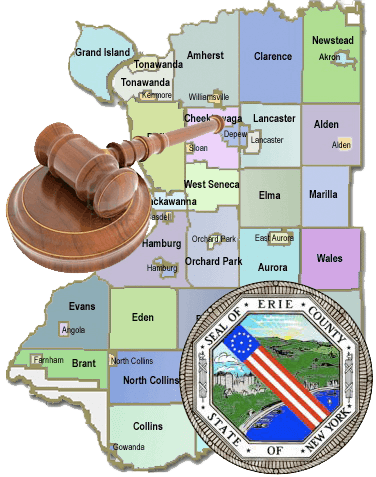
The most common point of confusion we hear is the relationship between the village court and the Amherst Town Court. Williamsville is an incorporated village inside the Town of Amherst, so the two courts coexist in the same geography but answer to different boundaries. A DWI issued on a road that lies within the village limits is typically heard in the Williamsville Village Court. A DWI issued in the surrounding parts of Amherst, outside the village, generally goes to the Amherst Town Court instead.
For a defendant, this distinction is not academic. The court named on your appearance ticket tells you where you must appear, on what date, and before which justice. Show up to the wrong building and you risk missing your own arraignment. One of the first things we confirm when we take a Williamsville case is exactly which court has the matter, so nothing is left to chance and every deadline is met.
The streets where village stops happen
Because the village is small and busy, enforcement concentrates on the corridors that carry the most traffic through it. The obvious one is Main Street, which doubles as Route 5 and runs straight through the village center past the restaurants and bars that draw an evening crowd. Add Union Road and Spring Street, and you have the handful of village roads where a DWI stop is most likely to begin.
On a Friday or Saturday night, Main Street through Williamsville is one of the more closely watched stretches in this part of Amherst. A stop can start with something minor, such as a rolling stop at a village intersection, a brake light out, or drifting near a parked car along the curb, and escalate quickly into a roadside investigation. Whether the stop began on Main Street (Route 5), Union Road, or Spring Street, the legal question is the same: did the officer have a lawful, articulable reason to pull the vehicle over in the first place? If that initial basis does not hold up, the observations, the field sobriety tests, and the chemical result that followed may all be open to challenge.
DWI and DWAI: what the village court will hear
A note on the charges themselves, because the difference between them drives the whole case. New York charges DWI (Driving While Intoxicated) and DWAI (Driving While Ability Impaired), and the village justice sees both. A typical DWI is charged at a blood-alcohol content of 0.08% or above and, for a first offense, is a misdemeanor carrying at least a six-month license revocation and a fine starting at $500. DWAI by alcohol, usually charged in the 0.05% to 0.07% range, is a traffic infraction and is frequently the target of a negotiated resolution. A reading of 0.18% or more elevates the charge to Aggravated DWI, and a second alcohol-related conviction within ten years can be prosecuted as a felony.
Whichever charge appears on your paperwork, the defense fundamentals do not change inside a village court. Was the stop lawful? Were the field sobriety tests administered to standard? Was the breath or blood instrument properly calibrated, maintained, and operated by a certified technician? Building a careful, documented answer to each of those questions is what often separates a conviction from a far better outcome.
What to expect at arraignment
The arraignment is your first formal appearance, and in the village court it tends to be a brisk, businesslike proceeding. The justice reads the charge, confirms you understand it, addresses bail or release conditions, and, in a DWI, typically suspends your driving privileges pending prosecution. It happens fast, and it sets the tone for the rest of the case. Having counsel beside you at that first appearance means someone is there to speak to release conditions, to begin protecting your ability to drive, and to make sure the record starts on the right footing.
From there the case settles into a rhythm of conferences and, where appropriate, motions. Because a village court runs its own calendar rather than feeding into a high-volume urban docket, there is often room to gather records, scrutinize the stop, and negotiate without being rushed. We use that room deliberately on behalf of every client.
Your license and the DMV refusal hearing
For most people, the practical fear after a DWI is losing the ability to drive. At arraignment the court will generally suspend your privileges, but we can often move promptly to secure hardship privileges and, in time, a conditional license so you can keep getting to work, school, and medical appointments while the case is pending. If you declined the chemical test, you also face a separate DMV refusal hearing (an entirely distinct proceeding with its own potential one-year revocation), and we handle that hearing in tandem with the court matter so the two are never working against each other.
The consequences reach beyond the license, too. A DWI conviction can bring an ignition interlock requirement on vehicles registered to you, higher insurance costs, a permanent criminal record, and complications for employment, professional licensing, and travel across the nearby Canadian border. Those collateral effects are frequently what worry our clients most, and they sit at the center of how we build a defense.
A firm rooted on Main Street
Plenty of attorneys advertise that they cover Williamsville. We are actually here. From our office on Main Street in the Village of Williamsville, we have defended DWI clients throughout Erie County for decades, and we bring that hometown familiarity to every village-court appearance. We know the streets the stops happen on, we know how the local courts run, and we know the community our clients live and work in, because it is ours too.
Just as important, we keep you informed at every step, from the day after the arrest through arraignment, motions, negotiation, and, if it comes to it, trial. You will always understand what is happening and why. To see the wider range of courts and communities we cover, visit our areas we serve page.
A DWI heard in the Williamsville Village Court deserves a defense from a firm that knows the village from the inside. Call Bakshi & Leta, right here on Main Street, at (716) 631-0004 for a free, confidential consultation.
Williamsville Village Court
Frequently asked questions
Call (716) 631-0004 for answers specific to your case.
The Williamsville Village Court is the justice court for the incorporated Village of Williamsville and handles offenses that occur within the village limits. The Amherst Town Court handles matters arising in the surrounding Town of Amherst outside the village. Where your DWI is heard depends on exactly where the stop took place, which is why the location on your ticket matters. Both apply the same New York Vehicle and Traffic Law.
A DWI or DWAI issued within the village limits, along Main Street (Route 5), Union Road, Spring Street, or another village road, is generally returnable in the Williamsville Village Court. Your appearance ticket or paperwork lists the date and time you are required to appear before the village justice.
Yes. Our office is at 5662 Main St., Williamsville, NY 14221, directly on Main Street in the Village of Williamsville, the same village this court serves. We work in this community every day, which gives us close familiarity with how local matters proceed.
No. A village justice court applies the identical DWI statutes, penalties, license consequences, and criminal-record exposure as any city court in New York. The differences are procedural and local: the court sits on its own schedule and is run by a village justice, which is exactly why local familiarity helps.
Charged with DWI in Williamsville? Call now.
The sooner you call, the more we can do to protect your license and your record in the Williamsville Village Court, and our office is right here on Main Street. Free, confidential consultation.